5 ways AI is changing what interviewers expect from senior engineers
AI is changing senior engineer interviews. Learn what candidates need to show around judgment, product thinking, risk, and AI systems.
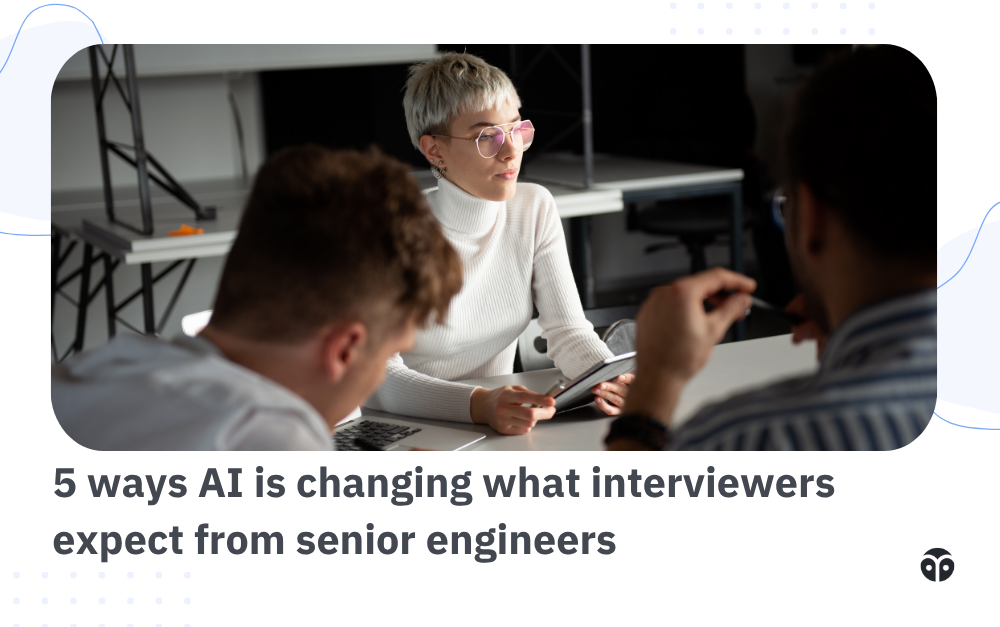
AI is showing up in senior engineering interviews more frequently now, whether it's a system design prompt, a product tradeoff, a coding workflow, or a conversation about how engineering work actually gets done.
The expectation isn't that you know every new AI tool or pattern. The expectation is that you can show judgment when the problem is changing, the workflow is less familiar, and the right answer depends on context.
Here are five ways AI is changing what interviewers expect from senior engineers in 2026.
The Ultimate SWE Interview Prep Guide
Built by engineers who trained interviewers at Meta and evaluated thousands of candidates, this guide breaks down what FAANG interviewers are actually looking for.
You’ll learn the algorithm patterns that show up again and again — from arrays and binary search to dynamic programming — and how to approach each one with more structure, clarity, and confidence.
1. Interviewers want to see how you handle unfamiliar problem shapes
AI is making senior software engineer interviews feel less predictable.
That doesn't mean every interview now requires deep AI experience. It means more prompts are starting to include systems, workflows, or product behaviors that feel less familiar than a classic coding problem or traditional system design question.
The interviewer may not be looking for the perfect AI answer. They may be watching how you respond when the problem has moving parts you can't fully memorize.
A strong candidate can:
- Clarify what the system is supposed to do
- Separate known facts from assumptions
- Keep the problem structured
- Make progress without pretending the ambiguity isn't there
That's an important senior signal because AI has made newer, less settled problems more common. The tools change. The patterns change. The product expectations change.
You don't need to know every term or framework. You need to show that you can reason through the shape of the problem and make grounded decisions.
2. Product judgment is harder to separate from technical judgment
AI is making product thinking more visible in technical interviews.
In a traditional system design interview, you might spend most of the conversation on scale, storage, APIs, latency, and reliability. Those still matter. But when AI enters the system, technical decisions often affect the user experience more directly.
For example:
- If the model gets the wrong context, the user gets a bad answer.
- If the system acts too freely, the user may lose trust.
- If the workflow is too slow, the feature may feel broken.
- If the AI sounds confident but wrong, the failure may be harder to catch.
That's why interviewers are listening for how you connect engineering choices to product outcomes.
A strong answer doesn't treat AI as a magic step in the middle of the architecture. It explains what the system needs from the model, what the model shouldn't own, and how the rest of the system keeps the experience reliable.
Interviewers want to know whether you can design the system and whether you can explain how the system behaves when the AI is uncertain, incomplete, or wrong.
That's where senior judgment shows up.
3. AI-shaped failure modes are part of the design
AI adds a failure mode that many traditional systems don't have: the system can succeed technically and still be wrong.
The service responds. The answer sounds fluent. The user may trust it. But the output may be incorrect, incomplete, or based on the wrong context.
That changes how senior engineers need to talk about risk in system design interviews.
Saying "we'll validate the output" isn't specific enough. You need to explain what validation means.
A stronger answer makes clear:
- What the system checks
- What source of truth it uses
- What happens when confidence is low
- When a human needs to approve the result
The level of validation should match the risk of the system.
A low-stakes answer needs a different level of guardrails than a workflow that can change accounts, trigger actions, or affect production behavior.
The point isn't to name every possible safety pattern. It's to show that you understand how AI can fail and how the system should respond.
That's a practical interview signal. It tells the interviewer you're designing beyond the happy path.
4. Review and judgment become higher-leverage work
AI is changing the day-to-day workflow of engineering.
As more work becomes AI-assisted, the engineer's leverage shifts toward steering, reviewing, choosing the right workflow, and deciding whether the output meets the bar. Senior engineers who use AI effectively already operate this way.
That doesn't make technical skill less important. It changes where technical skill shows up.
A senior engineer still needs enough depth to know when:
- The output is wrong
- The architecture is drifting
- An edge case was missed
- A solution works technically but isn't good enough for the product
That maps directly to senior engineering interviews.
Interviewers want to see that you can scale your review to the risk of the work. A small isolated change can move faster. A change that touches security, billing, infrastructure, customer data, or production behavior needs a higher bar.
This is a more useful signal than saying you use AI to move faster.
Speed alone doesn't tell an interviewer much. What matters is whether you know when to trust, when to verify, when to slow down, and when to push for a stronger answer.
5. The decision-making process matters more
Senior interviewers have always cared about process. AI makes that process harder to ignore.
Final code still matters. A solution needs to work. But polished code alone doesn't prove seniority, especially as more code can be generated, assisted, or cleaned up by tools.
In coding interviews, interviewers are watching how candidates get to the answer:
- What questions do they ask?
- How do they choose an approach?
- Do they use time well?
- Can they recover when something goes wrong?
A senior candidate doesn't just list every possible solution. They choose a path and explain why. They don't optimize for cleverness when a simpler solution is more likely to work within the interview. They don't get derailed by a small mistake or a forgotten API. They keep moving.
This matters because AI is changing what execution looks like, but it isn't removing the need for engineers who can structure ambiguous work.
If anything, it makes that skill more visible.
The final answer tells the interviewer whether you got there. The process tells them whether they'd trust you to get there again on a different problem, in a real codebase, with real product constraints.
Sign up for our newsletter
Get the latest in tech right in your inbox
What this means for senior engineers preparing for interviews
AI isn't replacing the senior engineer skill set. It's changing where that skill set shows up.
Judgment, technical depth, product thinking, and communication still matter. But in 2026, senior candidates need to show those skills in workflows where AI may generate code, suggest architecture, evaluate outputs, or take actions inside a larger system.
That means you need to practice more than the final answer.
You need to practice how you:
- Frame the problem
- Explain tradeoffs
- Reason through risk
- Keep the system grounded
- Make progress through ambiguity
The new bar isn't knowing every AI tool. The tools will keep changing. The bar is showing that you can use engineering judgment when AI is part of the work.
Practice the new interview bar with Formation
Formation workshops are built around the kinds of scenarios senior engineers are seeing in interviews now, including AI system design, coding judgment, behavioral signal, and how to talk through tradeoffs in real time.
If you want structured support beyond workshops, apply for the Formation Fellowship. You'll get a personalized roadmap, expert mentorship, and live practice across coding, system design, behavioral interviews, and negotiation so you can interview with more clarity and confidence.