Successful compensation negotiation: Handling an offer call
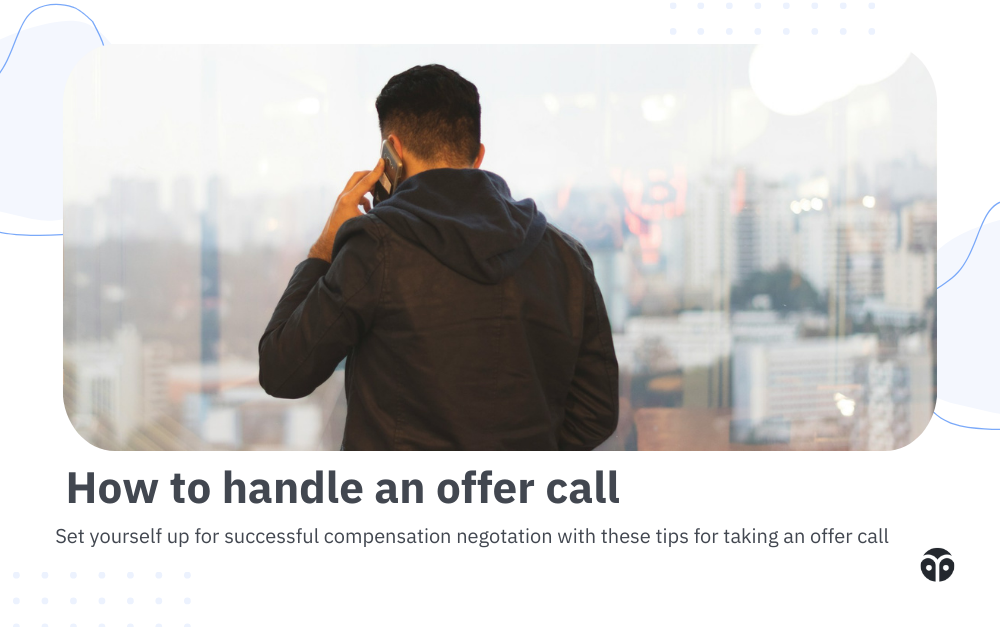
Here's how to handle an offer call so that you're in the best position for compensation negotiation.
You’ve made it.
You passed the onsite, and a company is very likely to extend an offer. It’s time to prepare for the offer call.
During this call, the employer typically presents the job offer, detailing the position, salary, benefits, and other employment terms. It's an opportunity for the employer to formally extend the job offer and for the candidate to ask questions about the role before accepting or declining the offer. This call is an important step because it allows both parties to clarify expectations and ensures that the candidate fully understands the offer.
This call is a critical step in the negotiation process. You want to avoid two things: asking for anything and accepting the offer on the call.
DO be aware: You and the recruiter have different goals
Up until this point, it usually seems like the recruiter is on your side. They’re a helpful, friendly face, navigating you through the interview process. You have to remember: their implied job is often to save the business money by getting you to accept the lowest offer that you're happy with.
On this call, recruiters are trying to
- Assess whether you’re excited about the opportunity and the offer
- Sell you on the opportunity
- Remind you what you’ve said in previous conversations and reflect this back to you
- Listen for clues about what you need to be able to accept the offer
- Understand your timeline
Throughout this call, you, as a candidate, want to
- Demonstrate enthusiasm for the people, the product, and the company
- Demonstrate neutrality and gratitude for the offer
- Demonstrate neutrality and gratitude for being informed of the benefits
- Set expectations for the timeline
DON’T ask for anything
There’s a simple reason for this: It’s hard to know what to ask for when you’ve just been given a lot of brand-new information.
For example, if you joined the call thinking you would ask for a $120k base, and on the call, they present you with an offer for a $120k base, your planned ask is no longer relevant. You may try to come up with something on the call, but it won’t be carefully considered as the best improvement to request, and you won’t have sound reasoning to present.
DO ask clarifying questions
This is your chance to learn more about the company, culture, benefits, and offer itself. Be ready with a list of questions related to your priorities.
Some examples include:
- Would you be able to share more about what factors were considered in putting the compensation package together?
- What types of health insurance are offered, and when does coverage start?
- Can you explain the retirement plans, and does the company offer matching contributions?
- What are the policies on paid time off, sick leave, and holidays?
For pre-IPO companies, where equity is offered:
- How is equity offered (RSU or ISO, for example)
- What are the tax implications of my equity?
- What are the terms of the equity?
- What is the vesting schedule?
- What’s the strike price (for ISOs)?
- What’s the preferred share price (for ISOs)?
- What’s the latest valuation?
DON’T accept the offer on the call
The first offer is rarely the best offer. If you’re a competitive candidate, it’s very likely that the expectation is that you’ll consider the offer and return with a request.
We also recommend that you don’t ask for the official offer letter. This often implies that you are ready to sign. If you are still considering the offer and are not yet ready to sign, then it would be best to either ask for an email summarizing the offer details or make your own notes about the offer details.
Example scripts to follow
Here are some common scenarios you might encounter during an offer call and how we suggest handling them.
How to convey excitement for the people, product, team, and company without giving too much away
Recruiter: Hello! I'm so excited to speak with you. I have some good news for you. The team felt you were extremely knowledgeable and had a wonderful time speaking with you. How did you feel about the team?
You: That's wonderful! I felt the same way! The interview was highly collaborative, and I learned a lot from each of the interviewers which was a good sign to me that [Company] is a good match. [Explain how you can immediately make an impact and contribute your skillset to help the company reach its goals]
Recruiter: We would like to move forward with an offer. The package we've put together is composed of a base salary of $100k, a signing bonus of $5k, an annual performance bonus between 10-15%, and we also have a learning stipend of $2000 annually. How does that sound to you?
You: That sounds interesting. I really appreciate you putting together an offer for me.
Recruiter: It doesn't sound like you're that excited about the offer.
You: It's an interesting offer. I'm considering it, and I have a lot to think about. Thank you for putting together an offer for me.
How to react with neutrality and gratitude to benefits
Recruiter: We have full medical/dental/vision for you and your dependents. We also have shuttles and snacks, unlimited PTO, and a very flexible work-from-home policy.
You: That's helpful to know more about the benefits as well.
How to set the timelines and deadlines
Recruiter: So, we would like to have an answer [by Friday]. Would that work for you?
You: I can definitely check in with you on [Friday]. I'm estimating I'll be able to make a decision closer to [next Friday].
Recruiter: Do you currently have other offers?
You: I'm wrapping up onsites soon, and [I'm nearing the offer stage with one company].
Recruiter: May I ask which other companies you're speaking with?
You: I'm speaking with a number of different types of companies; startups, large public companies. If I receive an offer, I'll be able to share more.
Recruiter: How does [Company] rank among the companies you're speaking with?
You: [Company] is one of my top choices. I really like [things] about the company.
How to respond to an exploding offer (red flag!)
Recruiter: We need an answer in the [next 24 hours].
You: Well, I can absolutely check in with you [tomorrow], and we can see where we're at.
How to respond to curveball questions
Recruiter: What number would get you to sign right now?
Answer: Right now, I don't have a number in mind. I'm considering many factors, and I want to discuss these aspects with family and friends.
Recruiter: Do you have a target you're aiming for?
Answer: As I mentioned, several factors make this opportunity incredibly attractive. I'm sure I'll have many questions, and if I do have a target or goal, I will be sure to share it with you in an upcoming conversation. [For the right company, I would consider accelerating my timeline.]
Get holistic interview prep with Formation
The Formation Fellowship gives mid-level and senior engineering job seekers everything they need to land their dream roles—including personalized skill brush-ups, unlimited mock interviews with experienced software engineers and hiring managers from top-tier tech companies, and offer reviews and negotiation support.
Apply here for unconditional support from a team of engineering mentors, technical recruiters, career coaches, and more.