How AI is rewriting the job description for senior software engineers
 November 25, 20255 min read

Across the industry, AI has sparked endless debate about the future of software engineering, especially for early-career software engineers. But there’s also a bigger, quieter shift already underway inside engineering organizations.
In subtle but sweeping ways, AI is redefining how engineering teams build, scale, and ship code. And that shift is increasingly visible in the changing responsibilities of senior engineers.
From Formation’s vantage point, AI isn’t flattening experience or making senior engineers less relevant. It’s doing the opposite. It’s amplifying the value of judgment, taste, and architectural reasoning, while converting those skills into a kind of throughput that didn’t exist three years ago.
This isn’t about job replacement. It’s about job transformation.
Fewer juniors, more seniors: the hiring mix is changing
A 2025 Harvard University study analyzing 62 million resumes found that companies adopting generative AI tools significantly reduced junior hiring, while senior roles remained stable or increased.
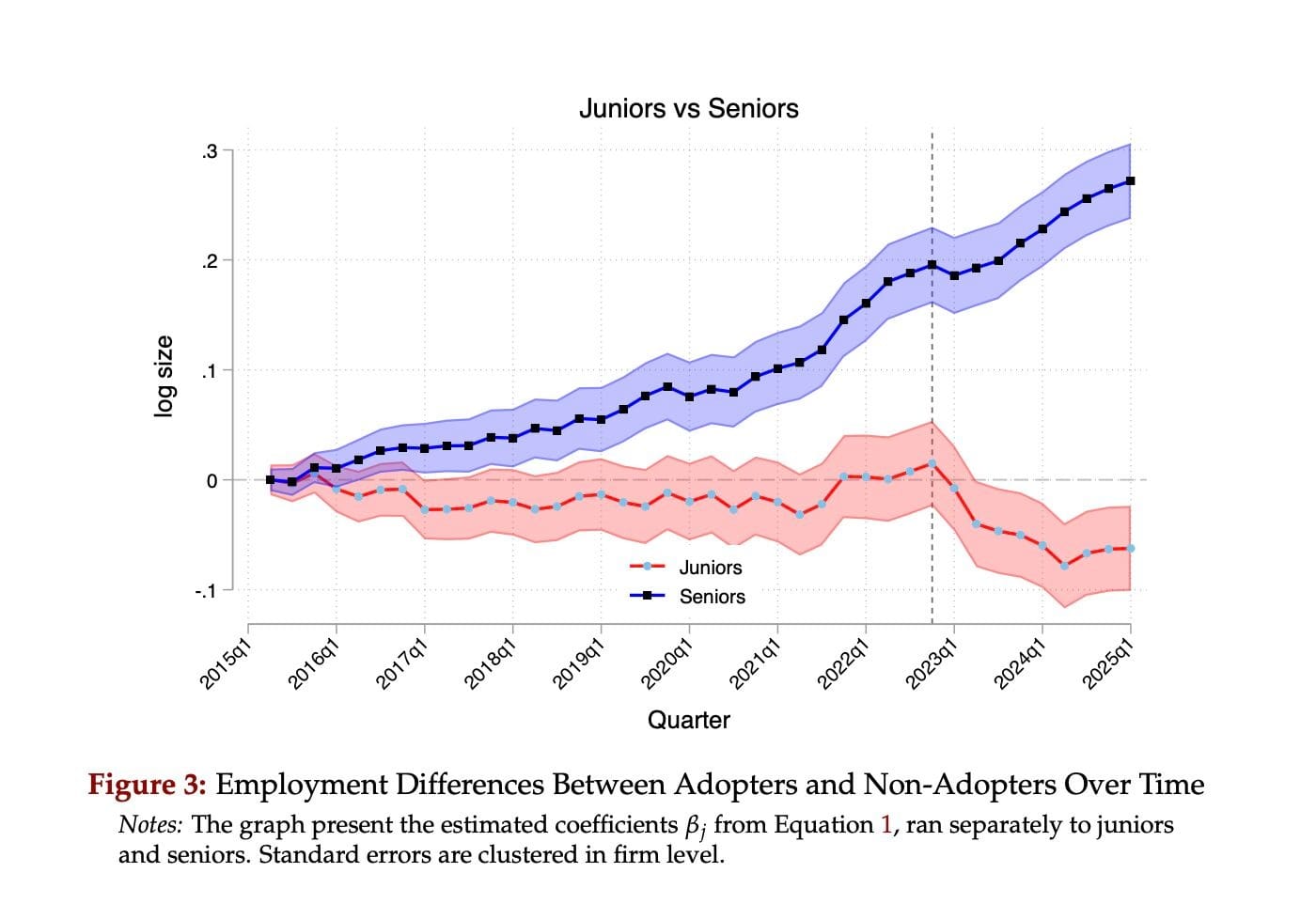
Why? Because AI tools make experienced engineers exponentially more productive, while simultaneously reducing the need for junior headcount to tackle boilerplate work. The economics favor leaner, more senior teams, better equipped to steer AI systems.
The labor data is unambiguous. Across multiple studies:
- AI-exposed firms reduce junior hiring while maintaining senior roles
- Early-career engineer employment in AI-exposed roles falls 13%
- Companies report a softening junior market as more low-level tasks shift to AI tools
- Job postings increasingly favor senior roles in AI-exposed functions
This creates a flywheel: senior engineers who can take on more AI-related responsibilities enable smaller teams to do more, which in turn reduces the incentive to hire large cohorts of entry-level developers.
Organizations are prioritizing engineers who can:
- Maintain system coherence in the presence of AI-generated code
- Review at a deeper level
- Set architectural patterns for AI tools to follow
- Manage security and integrity risks
- Mentor juniors in judgment, not rote execution
Sign up for our newsletter
Get the latest in tech right in your inbox
Software engineering productivity is going up, and so is the bar
The biggest surprise about AI-augmented coding isn’t how many tasks it can take over. It’s how much more value it unlocks when guided by experienced hands.
A 2025 study found that AI-supported Git workflows reduced PR review cycles by 31.8%, with top adopters pushing 61% more code to production. At Google, AI-assisted tools are credited with boosting engineering throughput by 10%.
But raw speed only tells part of the story. These gains don’t come from AI alone. They come from engineers who know how to design prompts, structure work, and catch AI’s blind spots before they ship.
That means companies are now optimizing for a very different skill set and a different kind of engineer.
Senior engineers should be systems thinkers
In a traditional setting, a senior engineer might own a project, design the architecture, write some key modules, and review code from the team. In an AI-augmented environment, that same engineer is now:
- Designing prompts to spin up initial code structures
- Setting architecture standards that AI tools will follow
- Reviewing AI-generated code for system-level coherence
- Mentoring juniors on tradeoffs and judgement
- Flagging model hallucinations or unsafe patterns
The job has moved up a layer. SWEs are orchestrating how code gets written, checked, and deployed. Engineers are becoming operators of intelligent systems.
Code review becomes more critical — and more technical
AI can refactor, restyle, scaffold, and even propose architectural shifts. But it cannot evaluate whether those suggestions align with the intent, patterns, or long-term stability of the system they belong to.
Senior engineers carry that sense of system integrity: the instinctive awareness that a seemingly small UI shift affects a shared container across multiple features, or that a new API shape silently drifts from the conventions used everywhere else.
This is where AI widens the experience gap:
- A less experienced engineer may accept AI’s solution at face value.
- A senior engineer asks AI for the full dependency chain, the downstream effects, and the potential regressions.
This reality raises the bar for senior engineers. Code review goes beyond identifying mistakes. It includes enforcing architectural integrity when the code generator doesn’t fully understand the system.
Seniors become the safeguard that ensures speed doesn’t degrade coherence.
Security and system integrity come into focus
AI increases throughput, but it also increases risk. More generated code means more potential vulnerabilities. Sophisticated attacks are already targeting AI-influenced workflows: injecting poisoned libraries, slipping malicious logic into auto-accepted PRs, and compromising the very tools developers rely on.
Security research reflects this shift:
- Analyses warn that AI is enabling malicious library contributions designed to evade conventional review.
- In its 2025 LLM risk guidance, OWASP flags weak model provenance, unsafe LoRA adapters, and dependency confusion as core risks in the AI engineering supply chain.
- PyPI has already confronted rogue AI-themed packages containing poisoned models and hidden malicious logic.
- The “ImportSnare” attack vector demonstrates how attackers use crafted documentation and module names to bias AI-generated code into importing unsafe packages.
As a result, senior engineers will increasingly function as system stewards. They help determine where AI-driven speed is safe, where it’s risky, and where guardrails are needed. This blends engineering judgment with strategic risk assessment in ways that were far less prominent a few years ago.
Mentorship shifts from how to why
With AI, junior engineers can generate functioning code with a prompt. But they can’t evaluate whether it’s the right code as easily. That’s where mentorship is shifting: from helping juniors with mechanics to helping them develop taste.
Senior engineers now mentor by:
- Explaining tradeoffs between two valid AI-generated paths
- Teaching how to interpret hallucinated output
- Helping juniors spot when AI's "good enough" code isn’t actually safe to ship
- Coaching toward systemic awareness rather than rote repetition
Internal AI practices are becoming part of the senior role
In the early days of Copilot and other assistants, AI use was up to the individual. Now, it’s becoming an organizational concern. Teams need policies for how AI is used, how outputs are reviewed, and how prompts are shared or standardized.
Senior engineers are often the ones:
- Drafting internal AI usage guidelines
- Creating prompt templates
- Leading review of AI-suggested changes
- Evaluating tool integrations across the stack
As AI becomes embedded in the workflow, defining "how we use AI here" becomes a function of technical leadership.
The role is expanding, not disappearing
AI isn’t eliminating senior engineers. It’s multiplying their impact. The best ones are no longer just high-output individual contributors. They’re becoming leverage points across the organization.
- One senior engineer with AI can do the work of several mid-level ICs
- Teams built around AI fluency favor strategic depth over headcount volume
- Companies are actively hiring seniors to lead AI adoption, integration, and process modernization
The bar for senior engineering roles is rising, but so is the opportunity. The senior engineers positioned to thrive will focus on four areas:
- Architectural literacy: Understanding how patterns, dependencies, and conventions influence AI output.
- Risk and boundary-setting: Knowing when to accelerate and when to intervene.
- Workflow orchestration: Designing task queues, prompts, and review processes that scale.
- Mentorship in judgment: Coaching juniors through tradeoffs and system reasoning, not just syntax.
These are the differentiators in an environment where AI’s strengths amplify the value of experience.
Dig deeper with Formation
The Formation Fellowship gives mid-level and senior engineering job seekers everything they need to land their dream roles — including personalized skill brush-ups, resume help, unlimited mock interviews with experienced software engineers and hiring managers from top-tier tech companies, career and negotiation support, and more.
If you’re having trouble navigating your job search on your own, apply here and get unconditional support from a team of engineering mentors, technical recruiters, career coaches, and more.
Formation Studio sessions are live workshops where engineers can pressure-test ideas, ask questions, and work through frameworks like this with an expert in the room. Instead of trying to apply a new workflow in isolation, you get to talk through where it breaks down, where judgment still matters most, and how to adapt it to the kind of work you actually do. Find one here.



