How to know if you’re ready for an SWE interview
 February 3, 20264 min read

Many software engineers delay interviewing because they don’t feel ready. Others jump in after weeks of grinding difficult problems and still feel blindsided when the interview doesn’t go as expected.
Both experiences usually come from the same misunderstanding: what interview readiness actually means.
Interview readiness isn’t about having seen every problem. You’re ready when your fundamentals are strong enough to help you solve problems you haven’t seen before.
Interview readiness starts with strong foundations
A common mistake in interview prep is using difficulty as a proxy for readiness. Engineers assume that if they can solve hard problems, they’ll be ready for anything an interviewer throws at them. In practice, this approach often backfires.
Interviewers are not evaluating whether you’ve seen a problem before. You don’t need to grind through thousands of LeetCode problems. They’re evaluating how you think through problems you haven’t seen. That means recall matters far less than reasoning.
There’s a meaningful difference between saying “I’ve seen this problem before” and being able to say “I can reason through this problem, even if it’s new.” Interview readiness sits in that gap.
At its core, readiness is a combination of strong fundamentals and adaptability. Everything else builds on top of that. Below are a few common signs of interview readiness.
1. You can reason through problems you haven’t seen before
If your prep relies heavily on memorizing solutions, interviews will feel unpredictable and stressful. Memorization creates a fragile sense of confidence that collapses the moment a problem looks unfamiliar.
Interviewers are trained to detect recall. When a candidate solves a problem too quickly or skips an explanation, many interviewers will introduce a variation or switch problems entirely to see how the candidate thinks.
A stronger signal of readiness is your ability to reason out loud. That means walking through how you understand the problem, how you break it down, and why you choose one approach over another.
Self-check: Can you explain why your approach works, not just what code to write? If the answer is yes, you’re building interview-relevant skill.
2. Your fundamentals hold up under pressure
Most interview problems are not novel inventions. They’re combinations of basic techniques applied in slightly different ways. When fundamentals are shaky, even medium-level problems feel overwhelming. You’ll be better prepared for interviews if your foundations are solid.
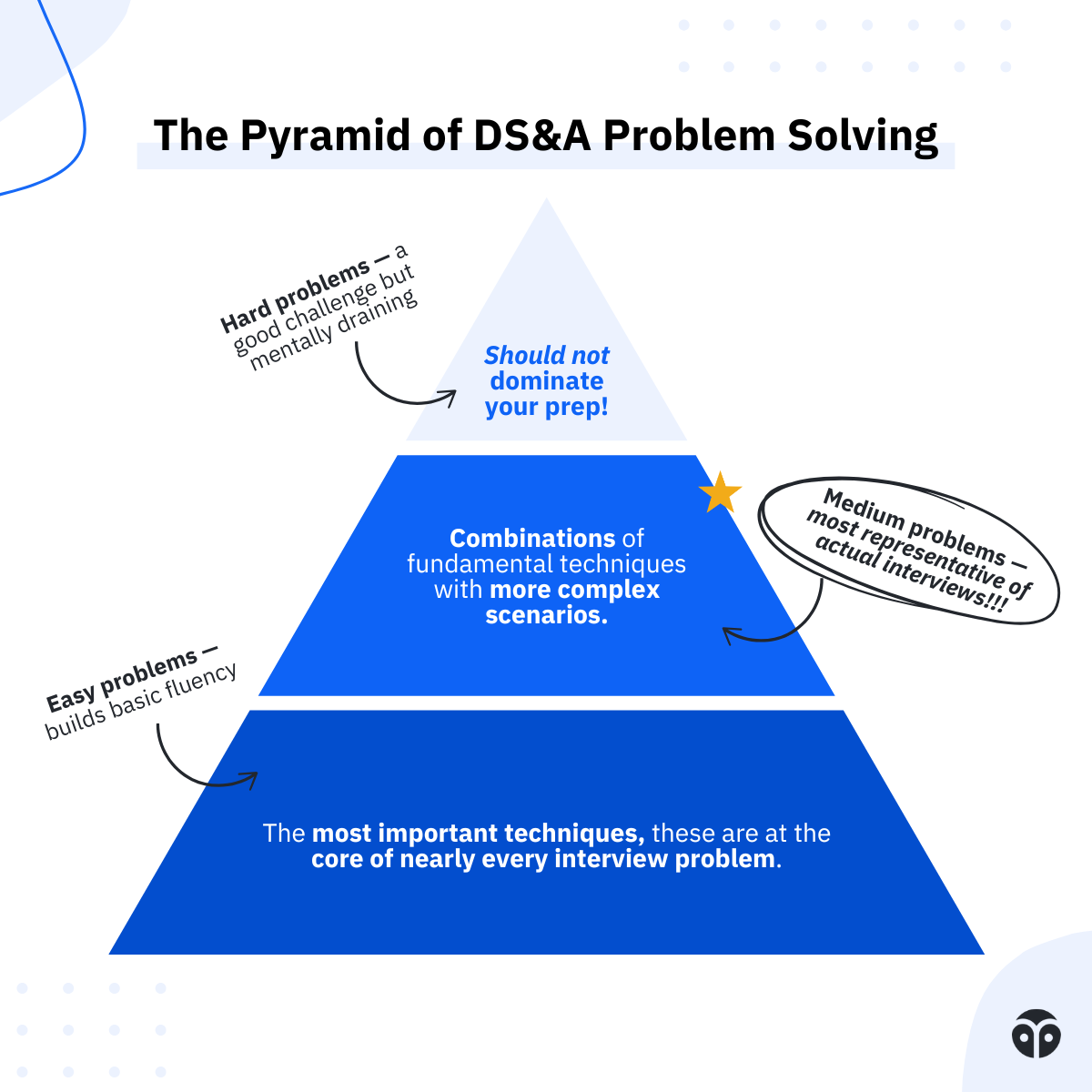
A useful mental model is a pyramid:
- Base: easy problems that reinforce core techniques
- Middle: medium problems that combine those techniques
- Top: hard problems that add complexity but appear less often
Weak foundations often show up in interviews when candidates know what to do conceptually but struggle with implementation, edge cases, or explanation when time is limited.
At the same time, interview readiness looks less like knowing specific answers and more like having a mental toolbox you can confidently reach for. “Easy” problems matter because they build fluency. Repetition across many easy and medium problems helps these techniques become second nature.
Signal of readiness: You can apply the same technique across different problem types without freezing or second-guessing yourself.
3. You can explain your thinking clearly and consistently
One of the most common pieces of interview feedback engineers receive is that their solution was correct, but their explanation was unclear. Communication is critical to a successful interview.
When fundamentals are solid, explanations tend to follow a clear structure:
- Framing the problem
- Outlining an approach
- Discussing tradeoffs
- Walking through edge cases
Practicing fundamentals silently isn’t enough. Interview readiness requires practicing them out loud. Explaining why a solution works forces you to confront gaps in understanding and improves clarity under pressure.
Clarity builds confidence, and confidence builds trust with interviewers. If you can consistently explain your thinking, you’re much closer to being ready than you might realize.
4. You can manage time and pressure reasonably well
No one performs perfectly in interviews. Readiness doesn’t mean being calm at all times. It means being able to function despite nerves.
A common sign of readiness under pressure looks like:
- Staying engaged
- Making steady progress
- Recovering from small mistakes
You can simulate interview pressure in low-stakes ways:
- Set time limits on practice problems
- Talk through solutions out loud with peers
- Start problems cold, without warming up
If nerves are present but manageable, that’s normal, and often a sign you’re ready to start interviewing. Practicing a mock interview with a qualified mentor is a good final step to assess your preparedness.
5. You know what roles you’re targeting
Interview readiness isn’t universal. It depends on the roles you’re pursuing.
Different roles emphasize different things:
- Entry-level roles often focus on coding fundamentals
- Senior roles emphasize tradeoffs, system thinking, and communication
- Startup and large tech interviews differ in structure and expectations
If your prep doesn’t align with the roles you’re targeting, interviews will feel harder than they need to be. A sign of readiness is clarity on scope, seniority, and interview format, and preparation accordingly.
Get ready with Formation
At Formation, we help engineers build interview readiness by strengthening fundamentals, practicing how to think and communicate out loud, and getting feedback from senior engineers and hiring managers from top-tier tech teams.
Our live, interactive workshops are led by mentors who’ve hired, coached, and interviewed at the highest levels, and give you space to practice in real time. You’ll be able to ask questions, pressure-test your answers, and see how interviews actually work today.
If you want hands-on preparation that builds clarity, adaptability, and confidence over time, explore our upcoming workshops to see what’s coming up next.



