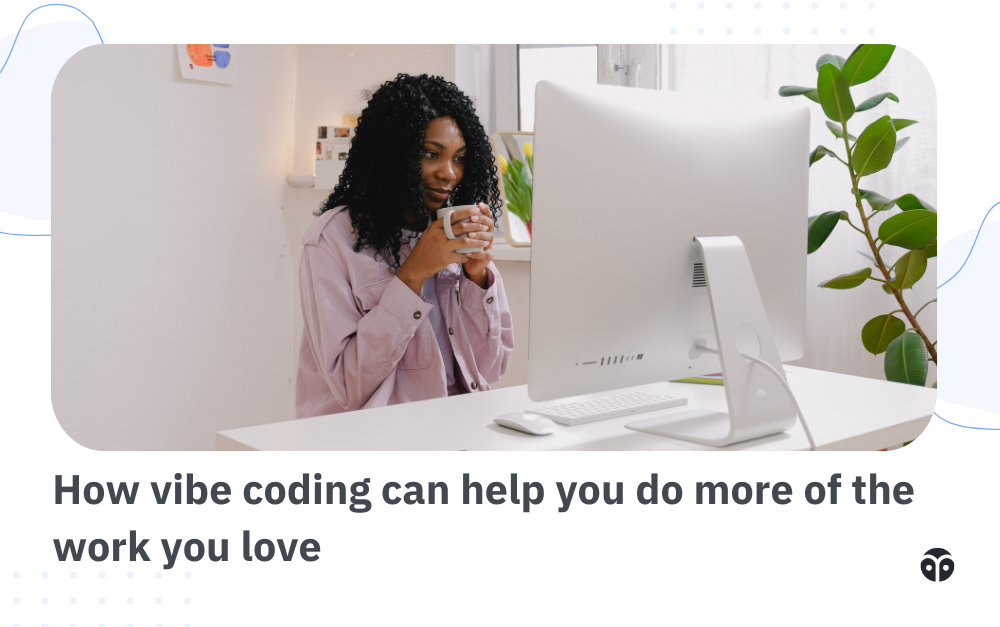
How vibe coding can help you do more of the work you love
Vibe coding can help engineers stay in flow and focus on meaningful work—without sacrificing review, security, or sound judgment.
Most engineers don’t get excited about writing boilerplate for the fiftieth time or writing test cases. It’s not that those tasks aren’t important — it’s that they tend to edge out the parts of the job that drew you in to begin with: designing better systems, thinking through tradeoffs, building things that make sense.
And while there’s no magic fix for the messiness of day-to-day engineering, vibe coding can help shift how and where you spend your energy.
What is vibe coding?
Vibe coding is a shorthand term that’s emerged to describe a different entry point into writing software. Instead of starting from a blank file or boilerplate template, you start with a prompt. You describe what you want, and a model gives you a first draft.
It’s still your code. You still shape it, test it, and review it. But you’re coming in with more of the structure already in place.
A few examples:
- “Create an Express route that accepts a POST request, validates the body, and writes it to MongoDB.”
- “Write a unit test for a function that filters expired sessions.”
- “Generate a reusable React component for an avatar dropdown with logout support.”
The idea isn’t to skip engineering work. It’s to move some of the repetitive typing (and the friction that comes with it) out of your way.
For engineers who’ve used these tools for a while, this already feels familiar. Copilot users report completing tasks 55% faster. Microsoft estimates that roughly 30% of the code their developers ship is AI-assisted. More and more, the default first step is to describe what you want and see what shows up.
Why it’s resonating now
The core appeal of vibe coding isn’t novelty. It’s relief from the repetitive parts of the job.
The 2023 Stack Overflow Developer Survey found that a significant portion of engineers spend more than half their time on code review, debugging, and maintenance tasks rather than net-new development. That doesn’t mean the work is unimportant. It means it’s mentally expensive. And it adds up.
Vibe coding isn’t a silver bullet. But it shifts how you approach that middle layer of tasks: not the architecture-defining work, and not the fully manual labor, but the stuff in between.
What you can (and should) offload
You don’t need to overhaul how you work to benefit from this approach. It tends to surface in small, incremental ways, often as a faster way into the parts of your workflow you’d otherwise try to avoid.
Start with the tedious parts of your job that slow you down.
1. Boilerplate and scaffolding
This is the most obvious win. You know the shape of this code already. You’ve written it in ten other services. It doesn’t require decision-making, just execution. LLMs are especially good here — config files, route handlers, interface declarations, and DTOs.
Let the model do the first pass. Even if you tweak it later, the lift is lighter.
- Routing logic
- Error handlers
- Basic API endpoints
- Component wrappers
- Form validation snippets
The goal isn’t to let the model take over design decisions. It’s to get you past the part you’ve already mentally solved.
2. Test case generation
Tests are essential, but writing them can be tedious, especially when the structure is predictable. Vibe coding often looks like prompting a model to scaffold unit tests, suggest edge cases, or spin up mocks.
Engineers are still in control of what gets tested and why. But the setup time gets shorter, and the entry point feels lighter.
3. Debugging and fix suggestions
Sometimes you’re just stuck on a loop that won’t behave, or an error message that doesn’t make sense. Vibe coding shows up in the form of low-stakes exploration. You ask for an alternative implementation. You prompt for a fix. You request an explanation in plainer terms.
Sometimes, that’s all you need to move forward.
It’s not going to replace your instincts, but it can be a helpful rubber duck that occasionally writes the answer down.
What changes when you work this way
When vibe coding works, it reduces the cost of iteration. You don’t lose 20 minutes switching contexts. You don’t spend the first hour of your day typing out patterns you’ve written dozens of times. Instead, you move into the part of the work where your judgment is most useful: reviewing, adjusting, thinking through the tradeoffs.
What changes isn’t just your output. It’s your attention.You:
- Get unblocked faster
- Stay in flow longer
- Spend more time evaluating, less time retyping
- Reclaim time for work that needs your full focus
Vibe coding doesn’t remove friction entirely. But it moves some of the stickier parts out of the way so you can think more clearly about the work that matters.
It still requires good judgment
None of this works without oversight. AI-generated code still needs review. It still needs to be tested, understood, and sometimes rewritten entirely. In fact, one of the fastest ways to lose time with AI is to assume it knows more than it does.
So while vibe coding can help you move faster, it doesn’t absolve you of ownership. You’re still responsible for:
- Verifying correctness
- Ensuring performance and security
- Fitting output into your architecture and style guide
- Using good judgment when the model makes mistakes
In other words, you’re still the engineer. The model is just your assistant — fast, confident, and a little prone to hallucination.
Vibe coding is a tool. Leverage it.
There’s no clean line between old workflows and new ones. Most engineers will live somewhere in between for a while.
But the practices that let you stay in flow longer, reduce friction without cutting corners, and preserve energy for the parts of the job that matter are the ones worth keeping.
Vibe coding doesn’t make your job easier in every way. But it might make it feel a little more like the job you wanted to be doing in the first place.
Get holistic interview prep with Formation
The Formation Fellowship gives mid-level and senior engineering job seekers everything they need to land their dream roles — including personalized skill brush-ups, resume help, unlimited mock interviews with experienced software engineers and hiring managers from top-tier tech companies, career and negotiation support, and more.
If you’re having trouble navigating your job search on your own, apply here and get unconditional support from a team of engineering mentors, technical recruiters, career coaches, and more.