How to build an AI personal project that stands out in interviews
Learn how to scope a personal AI project that shows problem-solving, product thinking, and technical judgment.
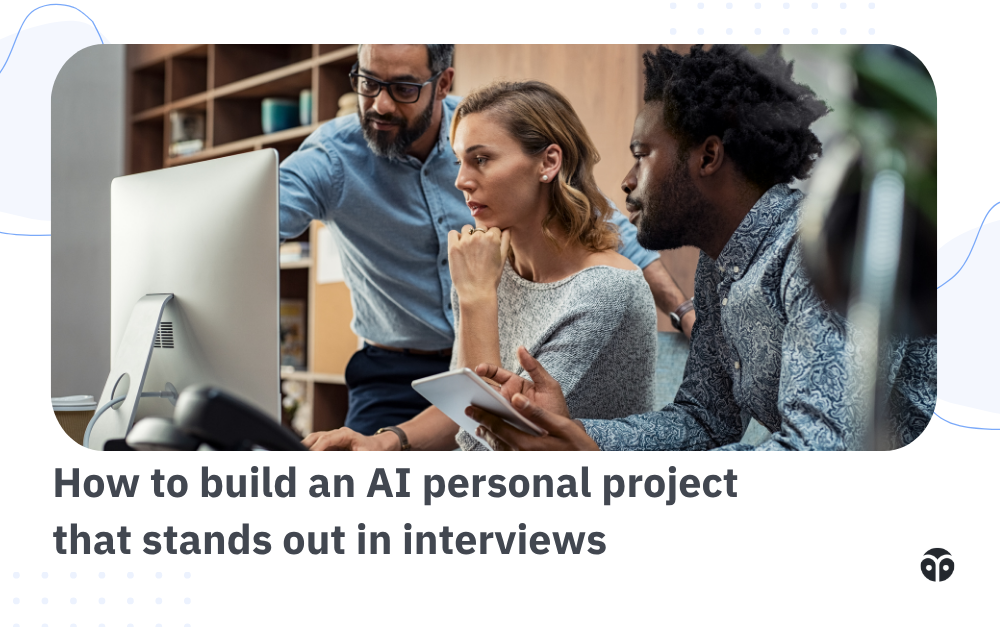
AI is showing up in more software engineering job descriptions, even for roles that aren’t strictly AI engineering roles.
That can create a frustrating gap for engineers.
You may understand the tools. You may follow what’s happening in the space. You may have experimented with LLMs, agents, RAG, or coding assistants on your own. But if you haven’t built AI features at work, it can be hard to point to something concrete in a resume screen or interview.
That’s where a personal project can help.
Want help scoping your AI personal project?
Formation is hosting a working session for fellows who want to build an AI personal project but aren’t sure what to build, how to scope it, or how to talk about it in interviews.
Come with a rough idea, a few directions you’re considering, or even just a problem space you’ve been circling. You don’t need a polished concept before you join.
By the end, you’ll have a problem statement in progress and a scoped project idea to build toward.
Why “I built an AI project” isn’t enough
Personal projects can be useful signals in a job search, especially when your work experience doesn’t yet reflect the kinds of roles you’re targeting.
But the project has to show how you think.
A hiring manager doesn’t only want to know that you used an LLM, connected to an API, built a chatbot, or added RAG. They want to understand the decisions behind the project:
- Why did you choose this problem?
- Who was it for?
- What did the user need?
- What context did the system need?
- How did you decide whether the output was good?
- What tradeoffs did you make?
- What would you improve if you kept building?
A project that starts with “I wanted to try RAG” can be hard to defend. It gives the interviewer a technology, but not a reason. It doesn’t explain why retrieval was needed, what information the system had to access, or how you knew the final answer was useful.
A project that starts with a real problem gives you more to work with.
For example, compare these three versions:
- Tech-first: “I built a RAG app.”
- Vague: “I built an AI productivity assistant.”
- Problem-first: “I built a tool that helps job seekers turn rough project notes into stronger resume bullets by identifying missing context, technical detail, and impact.”
The third version is more specific. It tells the interviewer who the project is for, what the user is trying to do, and what the system is meant to improve. It also creates room for deeper technical conversation.
That’s what makes a personal project useful in an interview. It gives you something to explain.
The best AI projects start with a real problem
Before choosing the stack, model, framework, or interface, you need to know what the project is trying to do.
A good AI personal project should answer four basic questions:
- What is the input?
- What is the output?
- What data or context does the system need?
- How will you know whether it’s working?
These questions force the project out of “cool demo” territory and into software design territory.
They also help you avoid two common traps: building something too broad to finish or building something too generic to explain.
“An AI career coach” is too broad. It could mean too many things. Does it review resumes? Suggest target companies? Practice behavioral questions? Recommend roles? Rewrite LinkedIn profiles? Each of those could be its own project.
A stronger version would be:
“I’m building a tool that helps software engineers improve resume bullets for technical projects. The user inputs a rough description of what they built. The system asks for missing context, then generates stronger bullets that include scope, technical choices, and measurable impact.”
That version is narrower, but that’s what makes it stronger.
Now the project has a clear input, a clear output, and a clear user workflow. You can reason about what data it needs. You can define what a good result looks like. You can make tradeoffs.
And when an interviewer asks why you built it this way, you have an answer.
Interview-worthy projects show product thinking
AI projects are often judged on more than technical implementation.
That doesn’t mean the technical work doesn’t matter. It does. But when you’re building a personal project, the technical choices are only meaningful if they connect back to the problem.
A hiring manager may ask:
- Why did this need AI?
- What could a non-AI version do?
- What does the model need to know to produce a useful result?
- What happens when the output is wrong?
- How did you evaluate quality?
- What did you choose not to build?
- What would you do next?
Those questions are easier to answer when you’ve scoped the project around a real user and workflow.
This is especially important for senior engineers. Interviewers are often looking for judgment: how you handle ambiguity, define scope, reason about failure modes, and make decisions when there isn’t one obvious answer.
A personal AI project can show that. But it has to be designed to show it.
If the project is only “I built a chatbot,” the conversation may stay shallow. If the project is “I built a chatbot that helps new pet sitters answer questions from a parrot care guide, with guardrails for when they should contact the owner or vet,” there’s much more to discuss.
You can talk about document retrieval. You can talk about user trust. You can talk about when the system should refuse to answer. You can talk about evaluation. You can talk about risk.
That’s the difference between a demo and a project that gives you interview material.
Sign up for our newsletter
Get the latest in tech right in your inbox
A lightweight PRD can make your project stronger
One of the simplest ways to improve an AI personal project is to write a short product requirements document before you build.
This doesn’t need to be long or formal. You’re not writing a full product spec for a team of 20. You’re creating a clear foundation for your own decisions.
A lightweight PRD should clarify:
- The problem
- The user
- What the user does today without your tool
- The proposed solution
- The input and output
- The data or context the system needs
- The first version scope
- The success metrics
- The risks or limitations
This helps in two ways.
First, it gives you a better build plan. You’re less likely to spend your first two weeks adding features that don’t matter or chasing a vague idea that keeps expanding.
Second, it gives you a better interview narrative. When someone asks, “Tell me about an AI project you built,” you’re not starting with the model or framework. You’re starting with why the project exists, who you built it for, and how you knew whether it was solving the right problem.
That’s much closer to how strong engineers talk about real work.
The PRD becomes the source material for your resume bullets, recruiter conversations, hiring manager interviews, and technical deep dives.
Your first version should be small enough to build
A strong AI personal project does not need to be huge.
In fact, the best first version is usually narrow. It solves one clear problem for one clear user in one clear workflow.
That can feel counterintuitive. When engineers want a project to stand out, they often try to make it bigger. More features. More integrations. More ambitious scope.
But bigger projects are harder to finish and harder to explain.
A smaller project can still show strong judgment if the scope is thoughtful.
A strong first version might include:
- One user workflow
- One clear input
- One useful output
- A small set of real or realistic data
- A basic way to evaluate quality
- A short explanation of what you’d improve next
That’s enough to show direction.
For example, you don’t need to build a full AI job search platform. You could build one focused workflow that helps engineers diagnose why a resume bullet is weak and rewrite it with stronger technical context.
You don’t need to build a full AI study coach. You could build one tool that takes a missed coding problem and helps the user identify the pattern, the mistake, and the next practice problem to try.
You don’t need to build a full customer support agent. You could build one assistant that answers questions from a small knowledge base and flags low-confidence answers for human review.
Each of those projects is small enough to scope. Each one still gives you room to discuss technical decisions, product tradeoffs, evaluation, and future improvements.
That’s the goal.
How to turn the project into an interview story
Once you’ve built the first version, the next step is learning how to talk about it.
The strongest project stories usually follow a simple arc:
- What problem you noticed
- Who you built for
- What the user was doing before your project
- What you built
- Why you scoped it that way
- What technical decisions you made
- How you evaluated whether it worked
- What you’d improve next
This is where the project starts becoming more useful for your job search. A good project story opens the door to a deeper conversation.
Formation Studio Workshops — free, live, interactive interview practice sessions for senior software engineers, designed around how interviews actually run at top tech companies. These aren’t passive webinars. They’re mentor-led working sessions where engineers think out loud, make decisions, and debate tradeoffs in real time.
What a strong AI personal project signals
AI experience can help you stand out in a software engineering job search, especially if your current role doesn’t give you many chances to build AI features.
But a personal project only helps if you can explain the thinking behind it.
The goal isn’t to build the biggest project possible. It’s to build something specific enough to show judgment.
Start with the problem. Define the user. Scope the workflow. Decide what data the system needs. Make a plan for evaluating whether it works.
Then build.
When an interviewer asks, “What are you building, and why?” you’ll have a real answer.
Ready to build stronger interview signals?
Formation helps software engineers prepare for competitive roles with structured interview prep, expert feedback, and a community of peers working toward the same goal.
If you’re trying to land more interviews, strengthen your technical interview performance, or build a clearer story around the work you’ve done, apply to the Formation Fellowship.